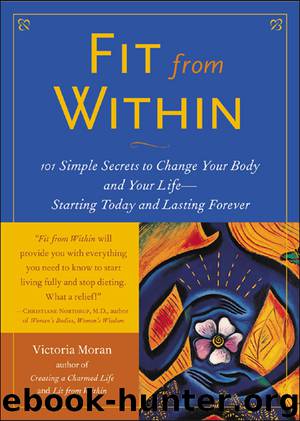
Fit From Within by Victoria Moran
Author:Victoria Moran
Language: eng
Format: epub
Publisher: McGraw-Hill Education
Published: 2002-03-13T05:00:00+00:00
50
BE CAREFUL WITH CAFFEINE
Those for whom a little caffeine yields a big rush find that is a temporary appetite suppressant. … When the short-term effect is over, however, the appetite can return with a vengeance.
COFFEE, TEA, AND DIET COLA—ah, the glorious “freebies” of almost every diet for the past forty years! But watch it with caffeine. People have vastly different tolerance levels for it. Some hardly notice a buzz. Those for whom a little caffeine yields a big rush find that it is a temporary appetite suppressant. (This is why it’s a common ingredient in over-the-counter diet aids.) When the short-term effect is over, however, the appetite can return with a vengeance.
Like drinking alcohol, caffeine consumption is part of human culture around the world. In places where coffee is uncommon, people make beverages from caffeine-containing herbs like maté, or they make the tea really strong so the morning lift you get in Bombay is not that different from the one you get in Boston.
Despite its popularity, caffeine is, pharmacologically, a stimulant to the heart and central nervous system. This isn’t all bad. Some studies have shown that caffeine makes people sharper mentally (until the effect wears off), and it’s a rare individual who can’t credit coffee or Coke for getting them through the day after a sleepless night. The problem arises when we need caffeine to get through every day or use it as a substitute for sleeping enough at night. If we do this for a long time, we can end up with weakened adrenal glands and an overall sluggishness that makes us look and feel older than we have to.
Whether or not you drink coffee, or how strong you take your tea, is a personal matter. If it doesn’t seem like a problem, it probably isn’t. I’ve found a distinct correlation in myself between binge behavior and too much caffeine. Sugar and refined carbohydrates, as well as large quantities of just about anything edible, are soporific. They make you tired. They can also “numb you out” mentally, taking the edge off anxiety. When I drink more than a little coffee, I feel the kind of agitation and uneasiness that I used to eat to tone down. I’ve heard some other overeaters, although certainly not all, say the same thing.
For the most part, then, I confine my caffeine intake to drinking tea—not too strong, and not pots and pots, but enough to get that little push without going overboard. (Green tea—the same plant as black tea but harvested earlier—has a light, distinctive flavor, less caffeine than regular tea, and it’s loaded with powerful antioxidants and with flavonoids that boost metabolism.)
The fact is, caffeine is addictive: people who quit cold turkey go through headaches, irritability, dizziness—symptoms similar to withdrawal from other drugs. I choose to have some of it with the full understanding that I am ingesting an addictive and somewhat mood-altering substance. If you drink coffee, tea, and cola—or use medications like Anacin or Excedrin that contain caffeine—you need to understand this, too.
Download
This site does not store any files on its server. We only index and link to content provided by other sites. Please contact the content providers to delete copyright contents if any and email us, we'll remove relevant links or contents immediately.
Inner Engineering: A Yogi's Guide to Joy by Sadhguru(6800)
The Power of Now: A Guide to Spiritual Enlightenment by Eckhart Tolle(5791)
Fear by Osho(4743)
Ikigai by Héctor García & Francesc Miralles(4280)
The Art of Happiness by The Dalai Lama(4133)
The Ultimate Bodybuilding Cookbook by Kendall Lou Schmidt(3950)
Yoga Therapy by Mark Stephens(3750)
The Little Book of Hygge by Meik Wiking(3698)
The Healing Self by Deepak Chopra(3589)
Why Buddhism is True by Robert Wright(3459)
The Hatha Yoga Pradipika (Translated) by Svatmarama(3353)
Being Aware of Being Aware by Rupert Spira(3283)
Shift into Freedom by Loch Kelly(3203)
Wild Words from Wild Women by Stephens Autumn(3157)
Work Clean by Dan Charnas(3131)
Happiness by Matthieu Ricard(3054)
More Language of Letting Go: 366 New Daily Meditations by Melody Beattie(3034)
Yoga Body & Mind Handbook by Jasmine Tarkeshi(2882)
Why I Am Not a Feminist by Jessa Crispin(2764)
